
Call Us
+86 136 6007 9809
Call Us
+86 136 6007 9809

Oct. 22, 2023
Metric tab lock washers are mechanical locking components designed to restrict unwanted rotation of nuts, bolts or other compatible threaded fasteners.
Their effectiveness does not come primarily from spring force or increased thread friction.
Instead, a properly designed tab washer creates a positive mechanical locking path between the threaded fastener and a stationary feature of the assembly.
This distinction is critical for engineers selecting locking hardware and for procurement teams evaluating replacement or cross-reference components.
The basic engineering principle is:
Stationary component → tab washer → threaded fastener
For the system to work correctly, both sides of that locking path must be defined.
JUXIN FASTENERS supplies standard and custom metric tab lock washers, DIN-style tab washers, locking washers and drawing-based stamped fastening components for industrial OEM applications.
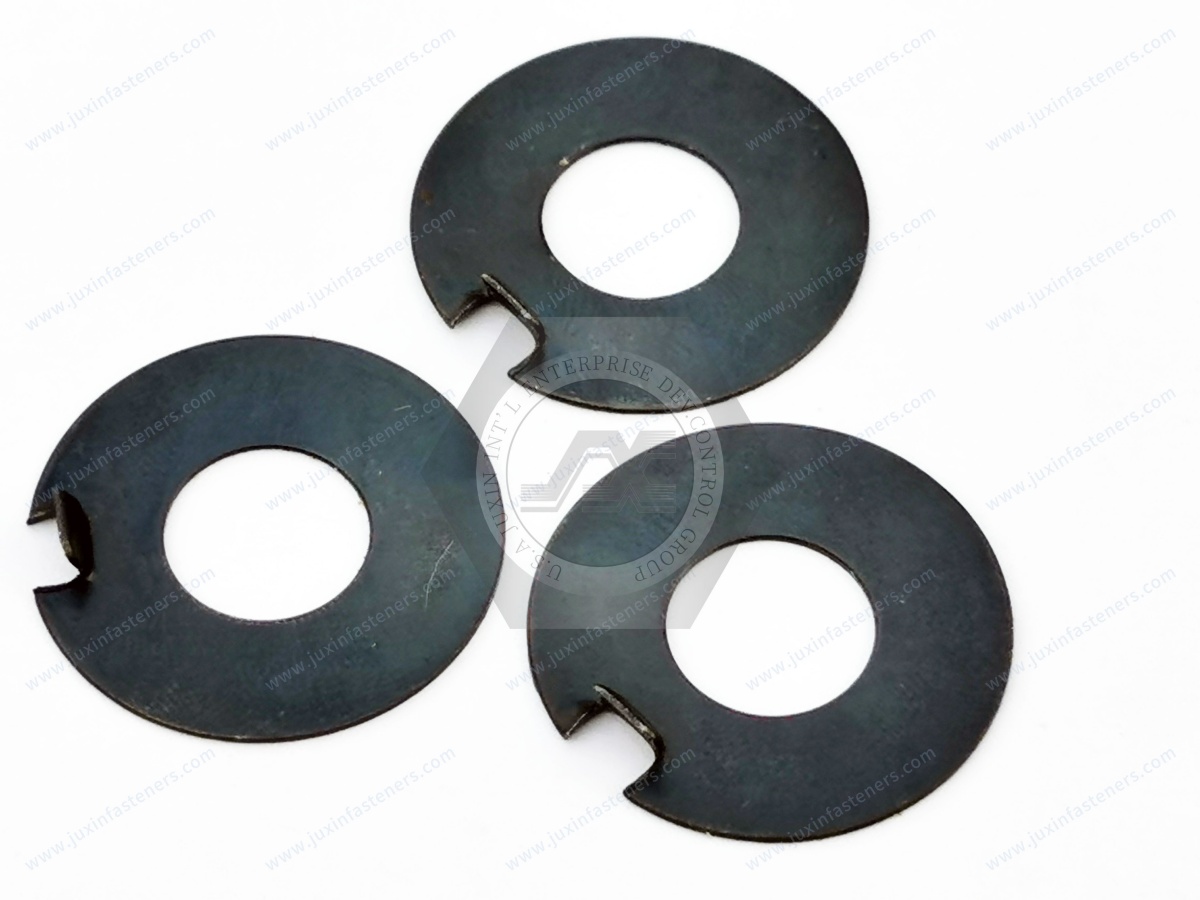
A tab lock washer prevents unwanted rotation by using one or more formed tabs, tongues or lugs.
Depending on the design, one washer feature may locate against:
a shaft keyway;
housing edge;
bracket;
slot;
machined flat;
other stationary structure.
Another feature is then bent or engaged against the nut or bolt.
The result is a physical anti-rotation connection.
For example:
Housing → locating tab → washer → locking tab → nut
or:
Shaft keyway → internal tongue → washer → external tab → locknut
The washer therefore functions as part of a mechanical locking system rather than as an isolated component.
Understanding this distinction prevents one of the most common specification errors.
Some locking systems depend primarily on:
thread friction;
prevailing torque;
serrated interfaces;
elastic contact;
chemical threadlocking.
A tab washer physically restricts rotation after installation.
The locking function is therefore determined by geometry:
Can the washer rotate?
Can the fastener rotate relative to the washer?
If either question is not addressed by the assembly design, the intended locking path may be incomplete.
The installation sequence matters because the fastener should normally reach its specified installed condition before the locking tab is finally formed.
A typical process is as follows.
Before installation, confirm:
nominal fastener or shaft size;
washer geometry;
inside profile;
material;
thickness;
tab configuration;
mating nut or bolt;
stationary reaction feature.
Do not select a tab washer based only on nominal thread diameter.
Two washers for the same metric size may use completely different locking architectures.
Determine what prevents the washer itself from rotating.
Depending on the design, this may be:
an internal tongue in a shaft keyway;
an external tab against a housing;
a locating lug in a slot;
another application-specific feature.
This step is essential.
If the washer rotates freely with the fastener, bending a tab against the fastener may not create the intended positive lock.
Install the washer in the required orientation.
Check that locating features are fully engaged and that the intended locking tab remains accessible after the fastener is installed.
Assembly clearance should be considered before tightening.
A geometrically correct washer can still be unsuitable if surrounding components prevent access to the locking tab.
Install the nut or bolt according to the approved assembly requirement.
The tab washer should not be used as a substitute for correct joint tightening.
The fastener establishes the joint condition.
The tab washer then restricts unwanted rotation.
These are separate functions.
For washers with multiple tabs, identify the feature that provides the correct locking relationship at the final fastener position.
Do not assume every tab must be bent.
In some designs, multiple tabs provide alternative locking positions rather than simultaneous locking points.
Form the designated tab against the appropriate nut flat, bolt head, slot or other locking feature.
The bend should establish mechanical restraint without unnecessary damage to:
the washer;
coating;
fastener;
adjacent component.
The required forming method depends on material, thickness and geometry.
Verify:
correct washer orientation;
correct locating-feature engagement;
correct locking tab;
adequate contact with the intended reaction feature;
no obvious tab cracking;
no unintended washer displacement.
The locking condition should be visually identifiable where the assembly design permits.
A common installation challenge occurs when the locking tab does not naturally align with the fastener after tightening.
The wrong response is to treat the washer as permission to arbitrarily change the fastener position.
The joint requirement comes first.
If alignment is repeatedly difficult, engineers should review:
tab spacing;
number of available tabs;
washer orientation;
mating nut geometry;
allowable fastener position;
alternative locking architecture.
The component geometry should support the required assembly process.
Not unless the approved assembly procedure specifically allows it.
Backing off a tightened nut can alter the joint condition and preload.
Where angular alignment is important, the locking system should be designed to provide a practical locking position without compromising the fastening requirement.
Multi-tab designs can sometimes provide greater alignment flexibility.
DIN 93 is associated with tab washer configurations used for mechanical locking of compatible fasteners.
The important engineering feature is the tab architecture.
Depending on the specific configuration, a tab can be formed against a suitable stationary feature or fastener surface to restrict rotation.
DIN 93 should therefore not be described as a spring washer whose main purpose is generating elastic preload.
Its locking principle is mechanical.
When sourcing a DIN 93 washer, confirm:
nominal size;
dimensional configuration;
material;
thickness;
tab geometry;
mating fastener;
assembly requirements.
DIN 432 represents another tab-washer architecture and should not be treated as merely a stronger or weaker version of DIN 93.
The correct comparison is based on geometry and intended interface.
When engineers compare DIN 432 with DIN 93, the useful questions are:
What fastener is being locked?
What stationary feature is available?
How is washer rotation restrained?
Where does the locking tab engage?
Is there sufficient installation access?
The appropriate washer is the one whose geometry matches the assembly.
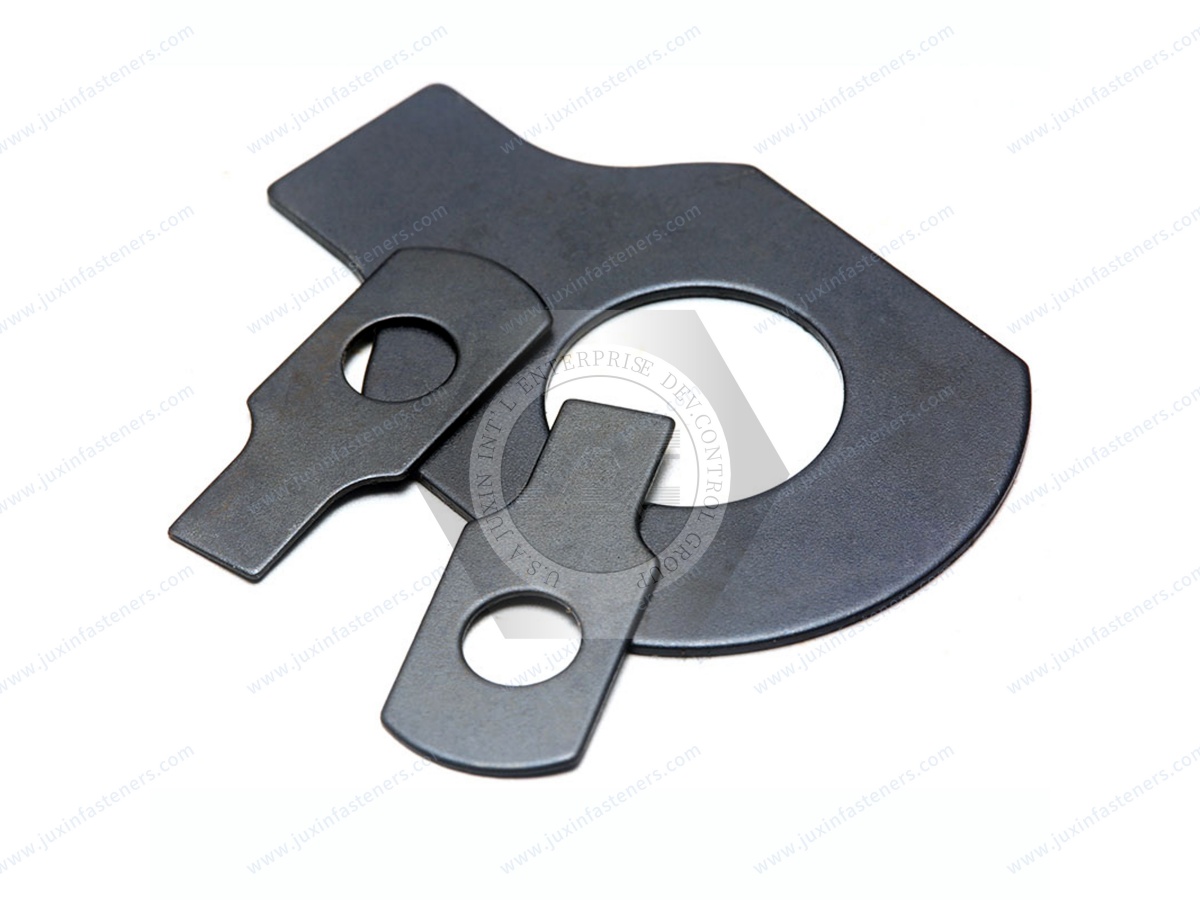
Do not compare them using statements such as:
"DIN 432 has more spring force."
or:
"DIN 93 has better vibration resistance."
Those statements oversimplify fundamentally different locking geometries.
Instead, compare:
| Engineering Question | What to Check |
|---|---|
| Mating fastener | Nut, bolt or other threaded component |
| Stationary interface | Housing, shaft, slot or other reaction feature |
| Washer restraint | How the washer itself is prevented from rotating |
| Fastener restraint | How the tab physically blocks fastener rotation |
| Tab accessibility | Whether forming is possible after tightening |
| Material | Strength, ductility and corrosion requirement |
| Service strategy | Whether disassembly and replacement are expected |
The assembly architecture determines the appropriate design.
A long tab washer uses an extended tab to reach a suitable locking or reaction surface.
The longer geometry may be useful when the locking point is positioned farther from the fastener axis.
However, longer does not automatically mean stronger.
Tab performance depends on:
material;
thickness;
unsupported length;
bend geometry;
reaction surface;
loading direction.
See our Long Tab Washers guide for detailed engineering considerations.
Double-tab washers incorporate two functional features.
One tab may restrain the washer while another locks the threaded fastener.
For example:
housing → long locating tab → washer → short locking tab → nut
This architecture can create a clear positive locking path.
However, two tabs should not automatically be described as providing twice the locking strength.
See our Double Tab Lock Washers engineering guide for further selection guidance.
Some metric locking washers are designed specifically for shaft and locknut systems.
An internal tongue can engage a shaft keyway while an external tab engages a compatible locknut.
The locking path becomes:
shaft → keyway → washer tongue → washer body → external tab → locknut
This is fundamentally different from a generic washer installed beneath an ordinary hex nut.
Replacement parts should therefore be cross-referenced by actual geometry, not simply by nominal shaft diameter.
The previous version of this article described some tab washers as preventing axial sliding.
That can confuse the function of the washer with the function of the complete threaded assembly.
A tab washer generally restricts rotation of the locking fastener.
The threaded nut, shoulder, bearing arrangement or other assembly components control axial positioning.
The tab washer supports the locking system by helping prevent the threaded component from rotating out of its intended position.
Another important engineering distinction:
A tab washer does not create the primary clamp load of the joint.
The fastener does.
The installation logic is:
Tighten the threaded fastener → establish the required joint condition → mechanically lock the final position.
This distinction matters when troubleshooting loose joints.
A correctly bent tab cannot compensate for an incorrectly designed or improperly tightened bolted joint.
Tab washer materials must satisfy both service requirements and forming requirements.
Selection factors include:
strength;
ductility;
formability;
fatigue behavior;
corrosion resistance;
temperature;
washer thickness;
post-installation bending.
Common options can include suitable carbon steels and stainless steels.
Carbon steel is suitable for many industrial applications and can support economical stamped production.
Surface protection may be specified according to the operating environment.
The material and processing route should maintain sufficient forming capability for the locking tab.
Stainless steel can provide improved corrosion resistance for suitable applications.
Grades may be selected according to environmental and mechanical requirements.
However, stainless steels differ in:
strength;
work-hardening behavior;
ductility;
corrosion resistance.
The material must remain compatible with the intended tab-forming process.
"18-8 stainless steel" is a broad commercial description rather than a complete engineering specification.
For controlled OEM sourcing, procurement teams should specify the required stainless grade or governing material specification whenever possible.
316-type stainless steels can provide improved resistance in certain corrosive environments compared with many general-purpose stainless grades.
However, suitability should still be evaluated against the actual:
chemical exposure;
chloride concentration;
temperature;
mechanical requirement;
mating materials.
"316 stainless" should not automatically be interpreted as universally corrosion-proof.
Steel tab washers may use surface treatments selected according to the application.
Possible requirements can involve:
zinc-based coatings;
zinc-nickel systems;
phosphate-based finishes;
other customer-specified protective systems.
For tabs bent after coating, coating behavior at the bend should be evaluated.
A coating that performs well on a flat stamped component may behave differently after severe local forming.
The previous article suggested composite materials as a general future direction.
That claim is too broad.
Positive locking tab washers depend on predictable mechanical deformation and load transfer through relatively thin locking features.
Alternative materials can certainly be developed for specialized applications, but they should not be presented as a general replacement trend without application-specific validation.
For industrial sourcing, proven geometry, material behavior and assembly validation matter more than broad "advanced material" claims.
Tab lock washers are commonly produced from sheet material using stamping and forming processes.
Manufacturing can involve:
blanking;
piercing;
tab cutting;
progressive stamping;
forming;
deburring;
heat treatment where applicable;
surface finishing;
dimensional inspection.
Production method depends on geometry, material and volume.
For many ordinary washers, inside diameter, outside diameter and thickness receive most attention.
For tab washers, angular position can be equally important.
If a tab is incorrectly located relative to:
the shaft keyway;
housing;
nut flat;
slot;
the washer may fit dimensionally but fail functionally.
For custom parts, tab orientation should therefore be treated as an engineering characteristic.
Where a tab bends affects:
reach;
stiffness;
forming force;
local stress;
final contact position.
A custom tab washer drawing should define the geometry needed to produce a repeatable locking interface.
Reuse should not be assumed.
A locking tab undergoes plastic deformation when bent.
During removal and rebending, the material can experience:
work hardening;
cracking;
permanent geometry change;
coating damage.
For service-critical assemblies, replacement after disassembly may provide a more controlled locking condition.
The OEM maintenance procedure should govern the decision.
Several errors can reduce the effectiveness of tab locking.
The locating feature does not engage the intended stationary component.
The tab is formed before the fastener reaches its required position.
Mechanical locking is treated as a substitute for correct preload.
A locating tab is mistaken for a locking tab.
The washer is repeatedly reused despite visible deformation or fatigue.
The washer fits the fastener but does not match the surrounding assembly.
The washer itself is free to rotate, leaving the mechanical locking path incomplete.
One advantage of tab locking is that the final locking condition can often be visually inspected.
An inspector can check:
washer orientation;
locating-feature engagement;
selected locking tab;
tab contact;
visible cracking;
gross deformation.
However, the appearance of a bent tab does not prove that the fastener was originally tightened correctly.
Torque or preload control remains a separate assembly requirement.
Tab lock washers can be used in suitable threaded assemblies within:
machine tools;
processing equipment;
gear drives;
industrial actuators;
material handling systems;
rotating equipment.
Selection should follow the actual mechanical architecture rather than a generic industry label.
Gearboxes can contain shaft nuts and threaded components where mechanical anti-rotation is required.
Important design factors include:
shaft geometry;
locknut configuration;
operating vibration;
service interval;
available installation space.
Compatible washer and locknut geometry should be evaluated together.
Bearing and shaft systems can use purpose-designed locking washers with compatible locknuts.
For these applications, procurement should verify:
shaft diameter;
keyway;
locknut;
washer dimensions;
standard or drawing reference.
A visually similar general-purpose tab washer should not automatically be substituted.
Pumps and compressors can expose fastening systems to vibration, thermal cycling and corrosive environments.
Where tab locking is specified, engineers should evaluate both:
mechanical locking geometry and material/environment compatibility.
Heavy machinery can contain threaded mechanical assemblies exposed to:
vibration;
shock;
dirt;
moisture;
service disassembly.
Tab locking can provide a simple and inspectable mechanical solution where suitable reaction geometry exists.
Mechanical assemblies within electrical and power equipment may use locking washers in:
enclosures;
actuators;
drive mechanisms;
rotating equipment;
support structures.
Electrical functionality should not be inferred merely because a metal tab washer is used.
Grounding or bonding requirements must be evaluated separately.
Tab washers can be used in suitable transportation-related mechanical assemblies.
However, application suitability should be established by the relevant drawing, specification and validation process.
A generic washer should not be marketed as automatically suitable for every automotive, rail or aerospace application.
The old article broadly claimed applications in aircraft, rockets and satellites.
That is too broad for a professional B2B engineering page.
Aerospace fasteners can require:
controlled specifications;
approved materials;
traceability;
special inspection;
qualification;
approved suppliers.
JUXIN FASTENERS should only claim aerospace suitability when the actual component and documentation support the requirement.
Standard DIN-style or other established washer geometries can be efficient where the assembly was designed around them.
Custom designs become useful when:
standard tabs cannot reach the reaction surface;
a proprietary housing is used;
angular position is unique;
space is limited;
a non-standard bore is required;
multiple locking features are needed.
JUXIN FASTENERS can manufacture custom stamped locking washers from drawings or samples for suitable OEM applications.
Procurement teams frequently search for replacements when an original washer becomes:
obsolete;
difficult to source;
subject to long lead times;
available only from a single supplier.
Cross-reference should compare more than nominal diameter.
Important characteristics include:
inside profile;
outside diameter;
thickness;
tab geometry;
tab position;
material;
finish;
mating nut;
shaft or housing interface.
The replacement should reproduce the required locking function, not merely the appearance.
For efficient technical review, provide:
2D drawing;
3D model where available;
applicable DIN, ISO or other specification;
metric fastener size;
mating nut or bolt;
shaft dimensions;
keyway or slot dimensions;
washer ID and OD;
thickness;
tab dimensions;
tab angular position;
material;
surface finish;
operating environment;
assembly drawing;
estimated annual volume.
For replacement projects without drawings, provide an unused sample where possible.
A washer drawing shows the component.
An assembly drawing shows the function.
For custom tab locking systems, the assembly drawing can reveal:
what restrains the washer;
what the tab locks against;
available forming space;
possible interference;
required tab reach.
This information can prevent a dimensionally correct but functionally unsuitable component from entering production.
For sourcing teams, use this sequence:
Standard number available?
→ Confirm exact standard and configuration.
Customer drawing available?
→ Manufacture and inspect against the drawing.
Only sample available?
→ Measure the component and evaluate the mating assembly.
Existing part obsolete?
→ Perform dimensional and functional cross-reference.
Standard washer does not fit?
→ Evaluate a custom stamped washer.
This reduces sourcing risk and unnecessary tooling changes.
Its primary function is to mechanically restrict unwanted rotation of a compatible threaded fastener.
Not primarily. Its defining locking mechanism is positive mechanical restraint created by its tabs, tongues or lugs.
No. They represent different washer configurations and should be selected according to the required assembly interface.
There is no useful universal answer. Their suitability depends on geometry, material, thickness, mating components and the required locking architecture.
Normally the fastener reaches its required installed condition first, followed by final tab locking according to the approved assembly procedure.
Do not assume this is acceptable. Backing off a tightened fastener can change the joint condition.
Reuse should not be assumed because the locking feature has undergone plastic deformation.
The complete threaded assembly controls axial positioning. The tab washer primarily restricts rotation of the threaded locking component.
Yes. Material selection should be based on corrosion, mechanical and forming requirements.
Yes. Custom tab geometry, dimensions, material and surface finish can be developed from drawings or suitable samples for OEM applications.
Successful tab washer selection begins with one question:
What creates the complete mechanical locking path?
Not simply:
What washer fits this thread size?
For design engineers, the washer should be evaluated together with the fastener, shaft, housing and reaction feature.
For procurement teams, dimensional interchangeability should be supported by functional interchangeability.
For supplier-development teams, drawings, mating-component information and assembly requirements provide a stronger basis for supplier qualification than product names alone.
JUXIN FASTENERS supports standard and custom metric tab lock washers, DIN-style tab washers, locking washers, stamped components and drawing-based fastening solutions for global industrial OEM applications.
For standard products, send the applicable standard, size, material and finish.
For custom components, send your 2D drawing or 3D model together with application and annual volume information.
For obsolete or replacement parts, send an unused sample where possible together with the mating nut, shaft or housing information.
Our team can support technical review, sample evaluation, cross-reference analysis, manufacturing feasibility, quotation and volume-production sourcing.
Email: info@juxinfasteners.com
Website: www.juxinfasteners.com
Previous: Bearing Nut Lock Washers
Next: Metric Tab Lock Washers
 MORE NEWS
Sep. 27, 2026
Sep. 27, 2026
Sep. 27, 2026
Contact Us
Tel.:
+86 020 8621 0320
+86 020 3121 6067
E-mail:
Technical Support:
Navigation
SEND INQUIREY